Discover Habbo's history
Treat yourself with a Secret Santa gift.... of a random Wiki page for you to start exploring Habbo's history!
Happy holidays!
Celebrate with us at Habbox on the hotel, on our Forum and right here!
Join Habbox!
One of us! One of us! Click here to see the roles you could take as part of the Habbox community!


Page 7 of 7 FirstFirst ... 34567
Results 61 to 66 of 66
  1. #61
    -:Undertaker:-'s Avatar
    -:Undertaker:- is offline Habbox Hall of Fame Inductee
    Former Rare Values Manager
    HabboxForum Top Poster


    Join Date
    Jan 2006
    Location
    Jerez, the Kingdom of Spain
    Country
    Spain
    Posts
    30,064
    Tokens
    1,124
    Habbo
    -:overtaker:-

    Latest Awards:

    Default

    Quote Originally Posted by Chippiewill View Post
    To be honest, I think the exact figure is irrelevant, Westminster could be churning out a bunch of meaningless legislation (like naming post offices.. *stares at the US*) driving the figure way down, or it could be pushing out few key pieces of legislation that make big changes (like putting tuition fees up). There's no point adding up apples and oranges together in the same statistic, it just confuses people. Really both parties are at fault for making the debate about something so meaningless.
    Yup, and it's also a question of how you measure law. Is it on a 1:1 basis? Is it weighted? If so, is it weighted by affect on other laws? Is it weighted by financial cost of implementing that law? And so on and so forth. It's like the Magna Carta or the Bill of Rights - on a 1:1 basis they'll be 0.000001% of British law over the past 800 years..... yet their effect on law is huge. How can you measure such a thing? I don't think you can really.

    On the debates though with another comment, I think these debates are much better than the Leaders Debates we had last time (which i'm not a fan of). At least with this issue we've had an hours worth of coverage and it involves facts, stats and quotes.... something you can't really have with the leaders debates as it just turns into a soundbyte competition. I'd like to see more of them styled like this Europe debate: NHS, Education, Environment, Crime, Immigration etc...


    And if you wanna buy me flowers
    Just go ahead now
    And if you like to talk for hours
    Just go ahead now


  2. #62
    Join Date
    May 2007
    Posts
    10,481
    Tokens
    3,140

    Latest Awards:

    Default

    Just had a look at the Yougov survey's weighting, the number of UKIP supporters on the poll was adjusted from 170 down-to 90. Having read reports of the methodology I would as always take the poll with a severe grain of salt.
    Chippiewill.


  3. #63
    -:Undertaker:-'s Avatar
    -:Undertaker:- is offline Habbox Hall of Fame Inductee
    Former Rare Values Manager
    HabboxForum Top Poster


    Join Date
    Jan 2006
    Location
    Jerez, the Kingdom of Spain
    Country
    Spain
    Posts
    30,064
    Tokens
    1,124
    Habbo
    -:overtaker:-

    Latest Awards:

    Default

    Not wanting to really reopen the 'how much law is EU law' question but Richard North has an interesting piece out this morning regarding this. He concludes what we did that you cannot really tell what percentage is EU law or not, but that Clegg was purposely skewing the HoC library report as it didn't conclude 7% and the same for the 75% figure. I think what I and others said on around half (50%) give or take depending on the legislation of that year was pretty much right.

    http://www.eureferendum.com/blogview.aspx?blogno=84820
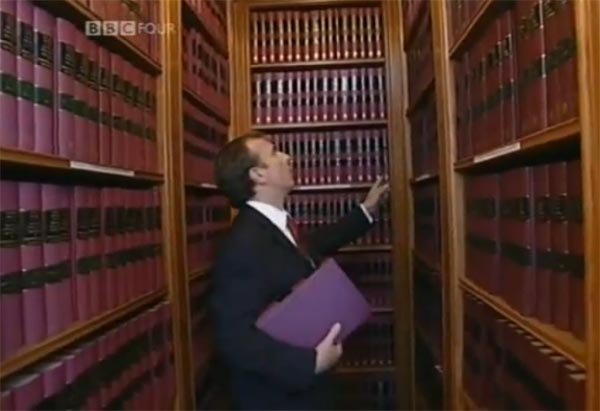

    Quote Originally Posted by Richard North
    Almost for as long as I can remember, there has been a debate about how much law the EU produces, with various estimates ranging - as we saw from Nick Clegg last night – from seven percent, to as much as ninety, as a proportion of UK law. We see something of the debate in this clip from This Sceptic Isle in 2006, with Peter Hitchens illustrating the sheer volume of the law pouring out of Brussels.

    But the clip also illustrates how long the debate has been going on – that was eight years ago. But Booker and I were thrashing this out in the early nineties, only then to come to the conclusion that the issue was irresolvable. There were too many imponderables and variables.

    Not least, there is an element of comparing chalk and cheese here. Of the nearly four thousand Statutory Instruments produced last year, a huge majority were road traffic orders, or administrative instruments of purely technical relevance.

    Thus, just taking a few off the database, for instance, we have the Financial Services (Banking Reform) Act 2013 (Commencement No. 4) Order 2014; the Non-Domestic Rating (Levy and Safety Net) (Amendment) Regulations 2014; the Marriage of Same Sex Couples (Use of Armed Forces’ Chapels) Regulations 2014; and the Air Navigation (Restriction of Flying) (Jet Formation Display Teams) (No. 3) Regulations 2014.

    Then we have the A46 Trunk Road (Stoneleigh, Warwickshire) (Temporary Prohibition of Traffic) Order 2014; the A5 Trunk Road (Upton Magna, Shropshire) (Temporary Prohibition of Traffic) Order 2014; the M5 Motorway and A46 Trunk Road (Ashchurch, Gloucestershire) (Temporary Prohibition of Traffic) Order 2014; the M32 Motorway (Junctions 1-3) (Temporary Prohibition of Traffic) Order 2014; the A46 Trunk Road (M4 Junction 18 to Cold Ashton Roundabout) (Temporary Prohibition of Traffic) Order 2014; the M4 Motorway (Junctions 17-18) (Temporary Restriction and Prohibition of Traffic) Order 2014; and so on and so on.

    In numerical terms, how can these possibly compare with, for instance, Commission Implementing Directive 2014/21/EU of 6 February 2014 determining minimum conditions and Union grades for pre-basic seed potatoes; Directive 2014/27/EU of 26 February 2014 amending Council Directives 92/58/EEC, 92/85/EEC, 94/33/EC, 98/24/EC and Directive 2004/37/EC of the European Parliament and of the Council, in order to align them to Regulation (EC) No 1272/2008 on classification, labelling and packaging of substances and mixtures; and Commission Implementing Directive 2014/37/EU of 27 February 2014 amending Council Directive 91/671/EEC relating to the compulsory use of safety belts and child restraint systems in vehicles?

    What we can do, of course, is quantify both sets of legislation, with enough accuracy to make a point. Roughly, there 3,969 General Acts and 71,851 UK Statutory Instruments on the UK legal database, making 75,820 in all. This compares with 20,868 EU acts (directives, regulations and decisions) currently in force.

    However, as numerous commentators have observed, not least Booker and I, it is impossible to make accurate comparisons, or come up with an accurate percentage, one with another. For a whole load of complex technical reasons, you cannot say that 20,868 EU acts represent "x percent" of the 75,820 UK laws.

    Thus, when Farage was confronted with Clegg insisting that "seven percent" of UK laws were made by the EU, he should not have tried to argue different percentages. Instead, had he been better briefed, he could have pointed to the House of Commons paper, on which Clegg relied.

    One should recall that the paper said that, "over the twelve-year period from 1997 to 2009 6.8 percent of primary legislation (Statutes) and 14.1 percent of secondary legislation (Statutory Instruments) had a role in implementing EU obligations …".

    In other words, Clegg, in insisting on the seven percent figure, was lying. The House of Commons says that 6.8 percent (rounded up to seven) of primary legislation (Statutes) had a role in implementing EU obligations, but 14.1 percent of secondary legislation (Statutory Instruments), also had a role. And since by far the more numerous quantum is SIs, to cite only statutes is completely to misrepresent the House of Commons briefing paper.

    This, though, does not gainsay the point that comparisons are fatuous. We should not make them, and to enter into an argument about comparative percentages is to get trapped into a battle you can't win.

    For sure, Farage could have slapped Clegg down on the seven percent figure, but – as we all know – Farage doesn't do detail, and money that could have been devoted to research has been spent on other things.

    In his place, I would then have quoted the number of EU laws (about 21,000) and the number of UK laws (about 76,000) and let the audience draw their own conclusions. But I could also have quoted the House of Commons paper, which retailed that the British Government had estimated that "around 50 percent of UK legislation with a significant economic impact originates from EU legislation".

    But what I most certainly would have done is quote the conclusion of the paper on which Mr Clegg relied, which said that, "there is no totally accurate, rational or useful way of calculating the percentage of national laws based on or influenced by the EU".

    One could, of course, say that this is being wise after the event, except that this argument is meat and drink to the eurosceptic cause. Going into battle with Clegg, Farage should have been better prepared. There was a good chance that this issue would have come up, and the House of Commons study is one of the definitive works on the subject.

    Gaming the issue, however, - as we discussed in our overnight piece, Farage could have taken the high ground, and outflanked Clegg with what would have been the unexpected assertion that much of EU law is made elsewhere, at global level, where we need to be.

    Often, when I criticise Farage (and UKIP), though, UKIP supporters lament than I am not being "constructive" and offering a "positive message". But, in fact, for many years, I have been arguing that UKIP's research capability is inadequate. And the "positive message" to take from that is very simple: it needs to be improved, as I was telling Farage to his face over ten years ago.

    What we saw last night, then, was Farage winging it. He was poorly prepared on important details, and played a poor tactical game. Had he been master of his subject, he could have slapped Clegg down with a few vital "killer points" and dominated the debate. Instead, as so often, Farage under-performed.

    This we cannot afford. If Farage is to present himself as the champion of the anti-EU movement, then he has to do much better the next time he meets Clegg. He takes our money. It's about time he earned his keep.
    There's also Andrew Neil on the BBC taking apart the 7% figure Clegg gave: http://order-order.com/2014/03/27/cl...to-be-fiction/

    Quote Originally Posted by Chippiewill
    Just had a look at the Yougov survey's weighting, the number of UKIP supporters on the poll was adjusted from 170 down-to 90. Having read reports of the methodology I would as always take the poll with a severe grain of salt.
    Yeah I saw that this morning. Guido has posted something on it too - http://order-order.com/2014/03/27/li...ly-lost-65-25/

    Tbh YouGov & Populus are always doing it. I only usually pay attention to Survation & Opinium.


    And if you wanna buy me flowers
    Just go ahead now
    And if you like to talk for hours
    Just go ahead now


  4. #64
    Join Date
    May 2007
    Posts
    10,481
    Tokens
    3,140

    Latest Awards:

    Default

    Quote Originally Posted by -:Undertaker:- View Post
    Yeah I saw that this morning. Guido has posted something on it too - http://order-order.com/2014/03/27/li...ly-lost-65-25/
    I think Guido actually misread, the Libdems were trying to give off the impression that the sample was heavily skewed to UKIP and hadn't been weighted (Whereas Guido interpreted the libdems as saying it had been weighted wrongly). This was almost true because the sample hadn't been demographically weighted (Which is what they quoted), but it had been (And arguably more importantly) political intention and referendum intention weighted.

    All in all the Libdems were being even slimier than Guido thought.
    Chippiewill.


  5. #65
    Join Date
    Mar 2005
    Location
    Bristol
    Posts
    5,642
    Tokens
    12,065
    Habbo
    djclune

    Latest Awards:

    Default

    Quote Originally Posted by Chippiewill View Post
    I think Guido actually misread, the Libdems were trying to give off the impression that the sample was heavily skewed to UKIP and hadn't been weighted (Whereas Guido interpreted the libdems as saying it had been weighted wrongly). This was almost true because the sample hadn't been demographically weighted (Which is what they quoted), but it had been (And arguably more importantly) political intention and referendum intention weighted.

    All in all the Libdems were being even slimier than Guido thought.
    I'm confused, was the original sample skewed or was the weighted one skewed?

    - - - Updated - - -

    Also, my friend shared this article on facebook from Vice.

    Link

    Usually I like vice but this articles ridiculous. The debate about whether we should be in the EU is more important than the individual trade deals the EU makes. They only had an hour to talk so it's not as if they could cover every possible aspect whereas vice is making it look like some sort of cover up.
    That's when Ron vanished, came back speaking Spanish
    Lavish habits, two rings, twenty carats

  6. #66
    Join Date
    May 2007
    Posts
    10,481
    Tokens
    3,140

    Latest Awards:

    Default

    Quote Originally Posted by The Don View Post
    I'm confused, was the original sample skewed or was the weighted one skewed?
    The original survey data is skewed with more members of UKIP taking part, it was weighted to represent national average across voting intentions. The libdems tried to make out that it hadn't been weighted at all by quoting the part where they didn't weight demographics.
    Chippiewill.


Page 7 of 7 FirstFirst ... 34567

Posting Permissions

  • You may not post new threads
  • You may not post replies
  • You may not post attachments
  • You may not edit your posts
  •